How to survive wolves in Lullwood
To survive wolves in Lullwood, never run in a straight line. The instant one wolf spots you, the others peel off to ambush points roughly 60 degrees either side of your escape line — so sprinting straight runs you into them. Cut sideways and reach bramble instead; the flankers trot, slower than the wolf still chasing you.
Why wolves are different
Bears and lions hunt alone. Wolves are the only predator in Lullwood that coordinates: the instant one wolf sees or scents you and enters a real chase, every other wolf that isn't already hunting on its own becomes a flanker, routed around you instead of at you. Treat three wolves as one animal and the other two arrive from your sides while you're still watching the one in front.
How the pack aims the flank
- Where the flankers go. Each flanker's ambush point is your own current movement heading, rotated 60 degrees to one side, out to about 1.4 times that flanker's own distance from you — the farther a wolf already is, the wider its swing. With three wolves hunting (the most that ever flank at once), the two flankers alternate sides: one angles ahead-left, the other ahead-right. Neither flanker aims at the chasing wolf — each one tracks only your heading and its own distance from you.
- Lag you can use. A flank path recomputes at most twice a second. Change direction and the pack's ambush points take up to half a second to catch up — long enough to turn a clean pincer into a wasted guess if you cut early.
The ambush itself
Once a flanker gets within about 4 units of its target point, it stops and sniffs there — 1 to 3 times, each lasting 1 to 4 seconds, so it stands planted anywhere from roughly a second to about twelve. It isn't blind while it waits: stumble into its sight or cross a live scent point near it and it converts straight into a real chase, the same as a roaming wolf would. If nothing re-triggers it, it gives up and returns to roaming immediately — no backing off, no searching, unlike a wolf that loses a direct chase and sweeps the area a few times first. And the whole pincer collapses together: the moment no wolf is still actively chasing you, every flanking wolf stands down too, even mid-sniff.
The speed gap that actually matters
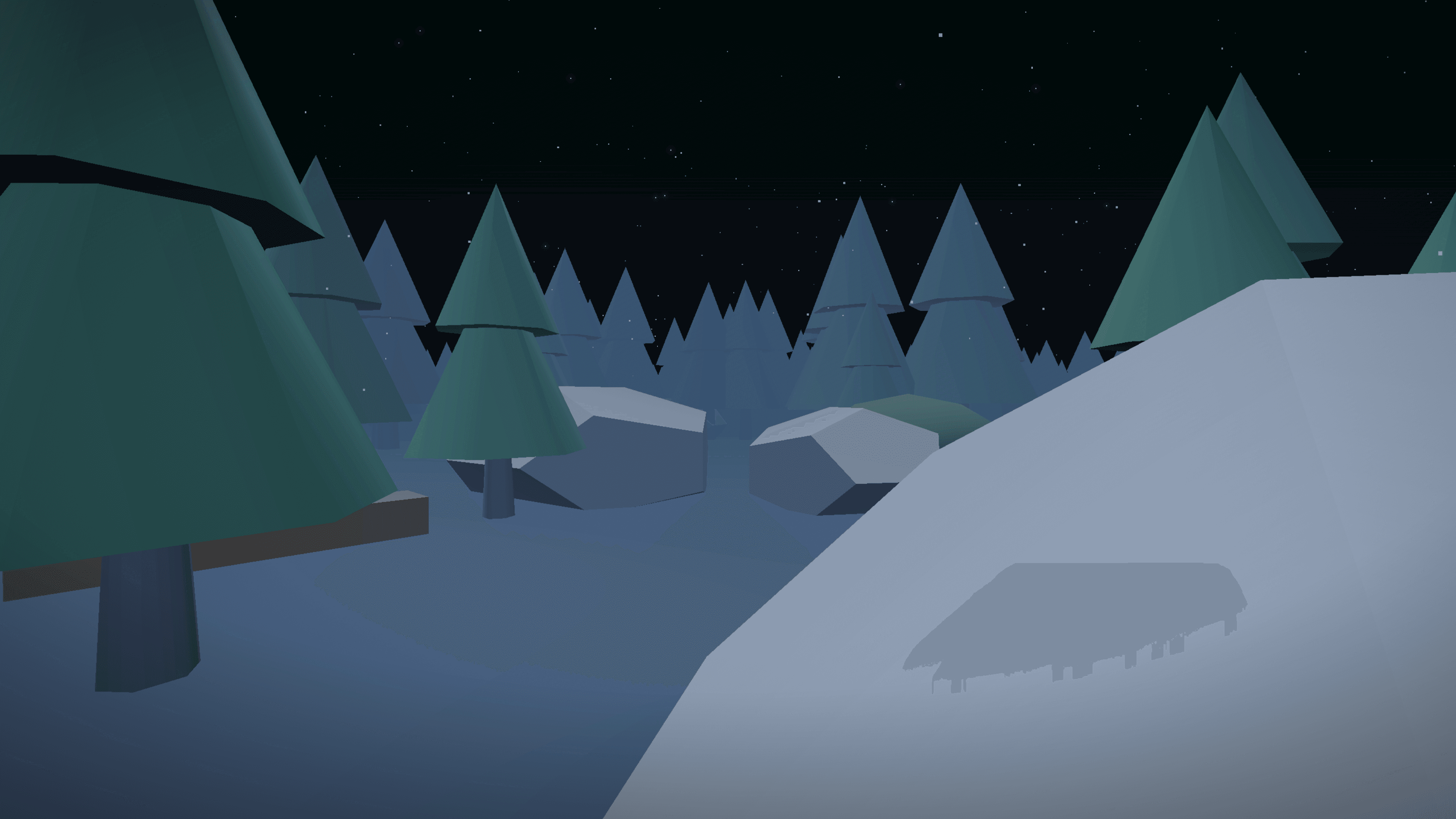
A wolf that has you in a real chase closes at about 15.5 units a second — you outrun nothing once it's on you. But a flanker on its way to an ambush point moves at a deliberate trot, well under half that speed: barely faster than your own walk. That trot is the one gap in the pack's math you can exploit — you can put real ground between yourself and a flanker even while the wolf actually chasing you is gaining on you, so cutting toward cover on a flanker's approach side, rather than away from the one chasing you, is often the faster way to bramble.
The Beacon Hunter: the one wolf the pack math doesn't cover
The first wolf placed into every run, on every difficulty, is permanently a variant called the Beacon Hunter — its eyes glow blue-teal once it locks on. It reads a fourth channel that has nothing to do with sight or scent: the moment you sprint against the wind within its ordinary sight range, it locks onto you outright, no line of sight and no scent trail required. Its lock range equals its normal sight distance — it isn't farther-sighted, it's a shortcut around the two senses every other predator needs both of. It is blocked by whatever blocks every other detection channel: the mist veil's overload burst and the game's rare cave immunity shut it out exactly like they shut out sight and scent for everyone else. The counter is simple once you know the trigger: don't sprint into the wind near a wolf you haven't identified, and if its eyes are already blue-teal, breaking line of sight alone will not end the chase.
Reading the geometry in the moment
- Lantern has no pack. One wolf per species means there is never a second wolf to send wide — a Lantern wolf chase is just a straight chase, nothing to flank with.
- Night and Blackout both run three wolves per species — enough for the full one-chaser, two-flanker shape. Night, with full-strength sight but a minimap to help you track where they've gone, is the easiest place to learn to read a pincer forming.
- Holding a straight line is what lets the pincer close. Because flank points are built off your current heading, a diagonal cut or a hard turn drags both ambush points toward wherever you're now heading — costing the pack the half-second recompute cap each time.
- Bramble beats the clock, not the wolves. Once you're hidden, a flanker that's already mid-approach keeps closing on its blind ambush point, not on you, and its own give-up timer starts running in your favor instead of against you.
The single thing to carry out of this page: wolves are the only predator in Lullwood that flanks, so the pack reads the same straight line you're running as an invitation, not a threat. Break the line, and you break the pincer.